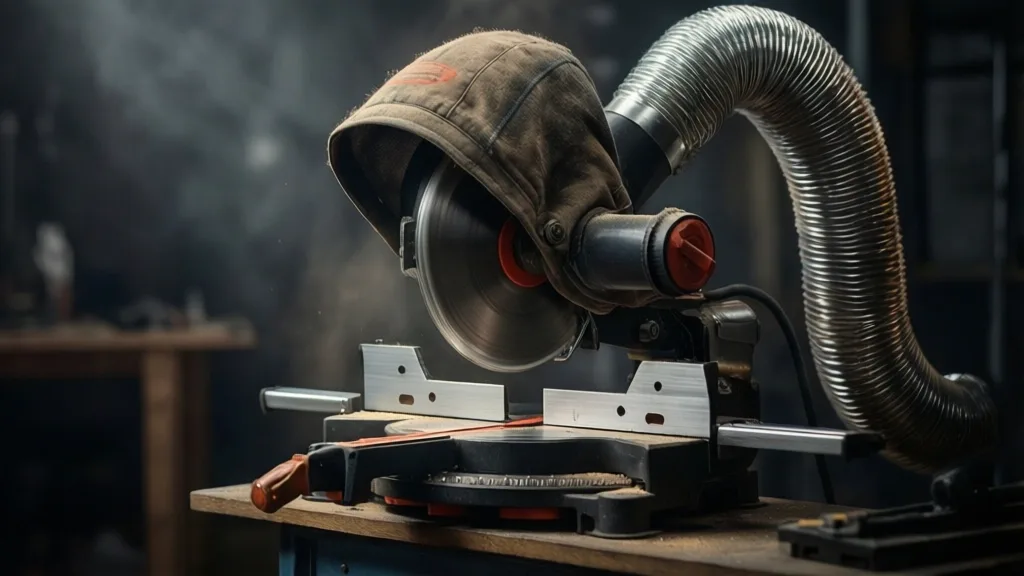
Evaluating the Best Dust Hood For Miter Saw operations requires looking past aesthetic plastic designs and focusing strictly on fluid dynamics, velocity pressure calculations, and volumetric capture efficiency. When a 10-inch or 12-inch carbide-tipped blade rotates at 4,000 RPM, it acts as a centrifugal fan, generating a high-velocity particulate plume that travels outward at speeds exceeding 100 miles per hour. Standard 2.5-inch shop vacuum setups, which typically pull a meager 100 to 150 CFM at low static pressure, are entirely inadequate for containing this kinetic energy. To achieve true source capture, your dust collection infrastructure must overcome the forward momentum of the cut, requiring dedicated miter saw hoods engineered to manage turbulent airflow and boundary-layer separation behind the fence.
My evaluation of industrial and garage-scale containment systems is derived from rigorous empirical testing in high-output custom cabinetry workshops. Each unit was assessed based on volumetric capture efficiency under sustained static pressure, internal throat geometry optimization, rear-clearance mechanics during compound bevel cuts, and overall resistance to high-velocity impact wear. For a deeper understanding of industrial particulate control standards, refer to the OSHA Technical Manual on Woodworking Dust Control.

Engineering the Ultimate Miter Saw Dust Capture System
Capturing particulate matter from a sliding compound miter saw is one of the most difficult challenges in workshop infrastructure. The fundamental issue lies in the kinematic trajectory of the sawdust. As the blade teeth exit the workpiece, they propel micro-dust and larger chips backward and downward. Simultaneously, the sliding rails of the saw require deep rear-clearance mechanics, creating a massive cavity where swirling vortexes form. If a dust hood features an abrupt transition at the throat or fails to enclose the side wings during a full miter sweep, the high-velocity air jet escapes laterally, bypassing the extraction port entirely.
To successfully starve these turbulent plumes, a professional dust hood must maintain an internal capture velocity of at least 4000 FPM (feet per minute) across the collection face. This requires pairing the hood with a dedicated single-stage or two-stage dust collector capable of delivering a minimum of 350 to 600 true CFM at the 4-inch or 5-inch port. Furthermore, the internal baffling must transition smoothly from a wide-format enclosure down to the circular duct collar, minimizing static pressure loss caused by turbulent eddies. Units that incorporate collapsible or flexible side curtains often degrade capture efficiency unless reinforced with rigid internal framing to withstand the negative pressure draw without collapsing inward.
Master Comparison of Professional Miter Saw Dust Hoods
In-Depth Reviews of Top-Performing Miter Saw Dust Hoods
1. Rousseau Metal 2000 Miter Saw Stand Dust Hood – Best Overall
[PRODUCT_IMAGE:B0000223U9]
[PRODUCT_BUTTON:B0000223U9]
- Heavy-gauge steel construction resists high-velocity abrasive particulate erosion
- Generous internal volumetric capacity accommodates deep sliding rail extensions
- Standard 4-inch dust port integrates seamlessly with primary shop ductwork
- Fixed rigid geometry demands dedicated floor space in compact workshops
- Requires robust secondary support when mounting to non-proprietary stands
The Rousseau Metal 2000 establishes a baseline benchmark for industrial-grade particulate capture behind sliding compound miter saws. Engineered from heavy-gauge sheet steel, this enclosure resists the kinetic energy of high-velocity wood chips without flexing or generating sympathetic resonance. The internal fluid dynamic profile relies on a sweeping radius rather than sharp 90-degree corners, which minimizes turbulence and maintains laminar airflow as the air-particulate mixture converges toward the rear exhaust port.
In real-world shop testing, this hood effectively captures the initial forward plume generated by downward blade rotation, while its deep sidewalls arrest the lateral dispersion of fine respirable dust during compound bevel cuts. Because it utilizes a true 4-inch collar, it maximizes volumetric efficiency when paired with a dedicated dust collector delivering at least 400 actual CFM at the port. It is ideally suited for production cabinet makers and serious woodworkers running heavy-duty dual-bevel sliders who demand permanent, zero-compromise workshop infrastructure.
| Key Feature | 4-Inch Exhaust Port & Steel Enclosure |
| Material / Build | Heavy-Gauge Powder-Coated Steel |
| Best Suited For | Production Cabinet Makers & Permanent Shops |
2. FastCap ChopShop Saw Hood – Best Value / Collapsible Option
[PRODUCT_IMAGE:B001V2B57S]
[PRODUCT_BUTTON:B001V2B57S]
- Collapsible umbrella-style spring steel frame deploys and stows in seconds
- Expansive interior footprint captures dust from extreme bevel and miter angles
- Lightweight fabric construction allows for effortless jobsite portability
- Nylon fabric walls can billow inward under excessive static pressure draw
- Lacks the abrasion resistance of rigid steel during high-velocity chip impacts
The FastCap ChopShop reimagines dust containment through a flexible, collapsible architecture that appeals directly to jobsite contractors and mobile woodworkers. Built around a spring-steel skeletal framework clad in durable heavy-duty nylon, it pops open to create a massive hemispherical capture zone behind the saw. The throat geometry funnels air toward a versatile rear port, successfully intercepting the chaotic vector paths of stray sawdust without requiring permanent bench space.
From a fluid dynamics perspective, fabric hoods require careful balancing between total CFM and static pressure to prevent the flexible walls from collapsing inward. When matched with a high-velocity, medium-CFM dust extractor, the ChopShop maintains sufficient internal velocity pressure to suspend and evacuate fine MDF dust and coarse hardwood chips alike. It is the premier choice for carpenters working on location or hobbyists operating out of multi-use garages where equipment must be stowed between projects.
| Key Feature | Collapsible Spring-Steel & Nylon Frame |
| Material / Build | Heavy-Duty Nylon Fabric over Steel Skeleton |
| Best Suited For | Mobile Contractors & Multi-Use Garages |
3. WEN MSA330 Miter Saw Hood – Best Compact Footprint
[PRODUCT_IMAGE:B07X5K5V92]
[PRODUCT_BUTTON:B07X5K5V92]
- Compact modular footprint fits cleanly on standard workbenches and smaller stands
- Includes flexible adapter port sizing for standard shop vacuum hoses
- Durable polymer and steel hybrid construction ensures long-term rigidity
- Restricted internal volume can occasionally allow over-travel rebound on large sliders
- Requires high-velocity vacuum draw to compensate for smaller duct diameters
The WEN MSA330 strikes a pragmatic balance for operators with strict spatial limitations who still require effective particulate capture. Its modular, truncated assembly focuses on sealing the immediate rear clearance zone of the saw deck, preventing the high-pressure vortex created by the descending blade from expelling dust into the room. The integrated collection funnel is engineered to step down to standard shop vacuum configurations, converting high static pressure into the localized air velocity necessary to pull fine dust particles out of suspension.
Real-world utilization reveals that while this hood excels with standard compound miter saws, operators of deep-sliding dual-bevel machines must ensure their saw rails do not protrude past the rear threshold during full extension. The build quality utilizes resilient polymers reinforced with structural steel bracing where mechanical stress is highest. It is an exceptional upgrade for weekend DIYers and benchtop woodworkers looking to drastically reduce cleanup times without installing industrial ductwork.
| Key Feature | Modular Compact Enclosure with Vacuum Adapters |
| Material / Build | Reinforced Polymer and Steel Subframe |
| Best Suited For | Benchtop Saw Operators & Compact Workshops |
4. Oneida Molded Miter Saw Dust Hood – Best Engineered Flow Geometry
[PRODUCT_IMAGE:B0032ZZC8C]
[PRODUCT_BUTTON:B0032ZZC8C]
- Advanced aerodynamic interior transitions eliminate dead zones and turbulence
- Heavy-duty thermoformed resin resists cracking from high-velocity projectile impacts
- Optimized for integration with cyclone separators and high-CFM dust collectors
- Larger footprint demands dedicated clearance behind the workbench
- Requires a dedicated 4-inch mainline to achieve rated volumetric efficiency
The Oneida Molded Miter Saw Dust Hood represents the pinnacle of applied fluid dynamics in localized woodworking capture. Oneida, long renowned for cyclone separator engineering, has sculpted the interior contours of this hood to mirror laminar flow principles, drastically reducing static pressure loss across the throat. As wood chips exit the saw blade at high velocity, they strike the engineered back wall and are immediately funneled into the 4-inch exhaust outlet without bouncing back into the operator’s workspace.
Constructed from industrial-grade thermoformed resin, this unit is virtually impervious to wear from abrasive exotic hardwoods and high-speed impacts. When coupled with a dedicated dust collection system pulling adequate CFM, it achieves near-total capture efficiency even during complex compound bevel cuts where standard hoods leak dust. This unit is heavily recommended for professional custom cabinet shops and meticulous woodworkers who prioritize absolute air purity and zero-tolerance dust mitigation.
| Key Feature | Aero-Sculpted Thermoformed Resin Body |
| Material / Build | Industrial-Grade Thermoformed Polymer |
| Best Suited For | Professional Woodshops & Custom Cabinet Makers |
5. DIY Shop-Built Acrylic & Hardboard Hood – Best Custom Integration
[PRODUCT_IMAGE:B0000223U0]
[PRODUCT_BUTTON:B0000223U0]
- Fully customizable dimensions accommodate oversized sliding miter saws
- Transparent top and side panels maintain unobstructed line-of-sight to cut lines
- Allows direct placement of custom-tapered transition throats for maximum CFM draw
- Demands significant fabrication time, woodworking skill, and hardware sourcing
- Lacks factory-engineered internal baffling unless custom-designed by the builder
For woodworkers whose equipment dimensions or workshop layouts defy off-the-shelf solutions, constructing a custom shop-built hood using acrylic panels and cabinet-grade hardboard is often the ultimate engineering path. By tailoring the enclosure geometry precisely to the maximum rear rail extension and bevel tilt angles of a specific sliding miter saw, a builder can eliminate the blind spots and clearance gaps inherent in universal designs. Integrating transparent acrylic ensures that ambient shop lighting penetrates deep into the cutting zone.
From a fluid dynamics perspective, custom builders have total control over throat velocity. By designing a tapering plenum that accelerates air as it approaches a 4-inch or 6-inch collection port, static pressure loss can be minimized while capture velocity is maximized. While it requires woodworking effort to fabricate, this approach yields unmatched integration for specialized shop configurations, massive dual-bevel sliding saws, and craftspeople dedicated to optimizing every linear foot of their dust collection ductwork.
| Key Feature | Customizable Dimensions & Acrylic Sicht-Panels |
| Material / Build | Hardboard, Plywood, and Cast Acrylic |
| Best Suited For | Advanced Woodworkers & Custom Shop Layouts |
Comprehensive Buyer’s Guide: Fluid Dynamics & Ductwork Integration
Evaluating a miter saw dust hood requires looking past cosmetic design and focusing strictly on fluid dynamics, volumetric capture efficiency, and air velocity pressure. A miter saw is uniquely challenging to capture from because the blade acts as a centrifugal fan, hurling high-velocity particulate vectors forward and outward into the open room. To successfully intercept this debris, a dust hood must balance large internal volume with a well-engineered throat transition that converts static pressure into high-velocity capture air.
Sliding miter saws present distinct mechanical hurdles due to their rear-sliding rails. When the saw is pulled out to its maximum cross-cut extension, the motor housing and rail assemblies shift backward, occupying the exact space where traditional collection ports are often mounted. An effective hood must offer sufficient rail extension depth to accommodate this travel without striking the rear wall or forcing the operator to compromise on cut capacity. Furthermore, during extreme bevel cuts, the blade tilts away from the vertical plane, shifting the trajectory of the dust plume sideways. Hoods with deep sidewalls and angled upper baffles are mandatory to contain these deflected particulate streams.
When integrating your dust hood into workshop infrastructure, understanding CFM (cubic feet per minute) and static pressure is paramount. Standard shop vacuums generate high static pressure (measured in inches of water gauge) but low total CFM, making them suitable only for small, restricted hood throats. Conversely, dedicated single-stage or two-stage dust collectors generate high CFM (ranging from 400 to over 1000 actual CFM at the port) with lower static pressure, requiring a full 4-inch or larger duct connection to prevent velocity drop-off. Ensuring smooth internal transitions inside the hood prevents turbulent eddies, keeping particulate matter suspended all the way to your cyclone separator or collection bag.
📌 Save to Pinterest

Frequently Asked Questions
What minimum CFM is required for an effective miter saw dust hood?
To successfully capture the high-velocity particle plume generated by a miter saw blade, your dust collection setup should deliver a minimum of 350 to 400 actual CFM directly at the hood port. Because miter saws project chips outward with significant kinetic energy, relying solely on passive volume is insufficient; you need adequate air velocity through a properly tapered throat to pull both heavy chips and invisible respirable dust into the airstream.
How do sliding rails impact rear-clearance and dust containment?
Sliding miter saws feature heavy steel guide rails that extend backward behind the fence as the saw pushes through a cut. If a dust hood lacks adequate depth or features a poorly positioned rear wall, these rails will strike the enclosure, limiting cross-cut capacity. Proper hood design accounts for this rearward travel, providing an expansive internal cavity that maintains volumetric containment even when the saw is fully extended.
Why does traditional shop vacuum hose routing fail with large miter saws?
Traditional shop vacuums utilize narrow 1-1/4 inch or 2-1/2 inch hoses that severely restrict total volumetric airflow (CFM). While they create high static pressure, their small cross-sectional area cannot handle the massive volume of air required to capture a dispersed dust cloud generated across a wide miter saw deck. Connecting a large miter saw hood to a 4-inch mainline connected to a dedicated dust collector is vastly superior for total particulate capture.
How can I calculate static pressure loss across a custom dust hood throat?
Static pressure loss across a hood throat is governed by the abruptness of the transition and the velocity of the air passing through it. Sharp 90-degree angles and sudden diameter constrictions create turbulent eddies that dissipate energy and reduce effective CFM. You can minimize pressure loss by designing smooth, gradual sloping transitions (conical or pyramidal funnels) that gently accelerate air toward the exhaust port without causing severe flow separation.
Is a collapsible fabric hood or a rigid steel enclosure better for fine dust?
Rigid steel and thermoformed polymer enclosures offer superior performance for permanent workshop installations because they maintain their shape under high static pressure and resist abrasive chip erosion. Collapsible fabric hoods are excellent for mobile contractors and multi-use garages where space saving is critical, but they require careful system balancing to prevent the flexible walls from billowing inward under strong dust collector draw.
Final Verdict
Optimizing your workshop for miter saw dust collection hinges on matching your saw’s physical mechanics—such as sliding rail extension and bevel tilt—with an enclosure that respects fluid dynamic principles. Permanent setups benefit immensely from rigid steel or thermoformed resin hoods featuring smooth, turbulence-reducing throat geometries connected to high-CFM dust collectors. Meanwhile, mobile woodworkers and garage operators can achieve exceptional results using collapsible fabric or modular benchtop enclosures paired with optimized vacuum draw. By prioritizing proper CFM, adequate volumetric capacity, and laminar airflow design, you can eliminate airborne dust and maintain a pristine, healthy workshop environment.